When did you last read or listen to a poem? It was likely recently, and probably today. Poetry is everywhere. First, it is in songs we listen to in the car on the way to work. Poems hide within the greeting cards we receive from friends and family. Commercials, children’s stories, and the prayers we pray contain poetry. Poetry bombards many of us every day of our lives, whether or not we are aware of it.
But when was the last time you were aware you were consuming poetry? How long has it been since you reflected on what you were reading, what the words said, and noticed the patterns in these words? The answer for many has a resoundingly negative response.
Our world possesses fast-paced and in-your-face endless entertainment choices. Plus, with modern media formulated to our tastes and biases, many don’t go out of their way to absorb themselves into a poem.
So why choose poetry?
Possibly you want to tell someone you love them, maybe you want to describe a beautiful scene, or perhaps you are angry at a perceived injustice. In truth, poetry gives us the tools to communicate these emotions. After all, we don’t just want to say I love you, that scene is beautiful, or I’m angry by this mistreatment. Alone, saying those words has little to no meaning.
We desire to feel love. And with metaphor, descriptive imagery, and the litany of other poetic devices, we touch and see the words. Did you ever share a song you liked with someone you love? Sure you did. We choose poetry to add the details and the personal flair even if those words belong to another.
Poetry is alive and palpable and evokes sensations everyone is familiar with from their everyday life. A poetic kiss isn’t just a kiss but a vulnerability to be heartbroken. It does this by not just saying we kissed, and I felt vulnerable. Instead, it says we kissed, and the air swirled between and around us. I felt as if we caught a breeze in the space between our lips. And when we let go, it ran away with the wind.
Neruda doesn’t just say he wants to love but compares his love to the inviting season of spring bringing the cherry trees to life.
Poems Reflect Our World
We do not get put into this world. Instead, we grow out of it. We receive a name. Upon this name, we build ourselves: our relationships, our careers, our memories, and our identity. The ego, therefore, constructs itself, and so we become disconnected from the world and our spirit.
Poetry is a way we reconnect to a world more meaningful to the temporary day-to-day. Poetry connects the rising power within many to the future and the past. The things we do to survive will pass. But through poetry, the dreams we dream live on for as long there are readers.
With a few carefully crafted words, a poet from the past brings their world and emotions into the present. And a poet in the present brings their world into the future. Poems have no other but the reader and the writer. Yet, the ambition for poetry is ironically birthed from our egos but at the other end received with our spirit. And as long as there are readers, there will be poets showing the world exactly how they feel. Transcribing their truth to another and then to another and so forth.
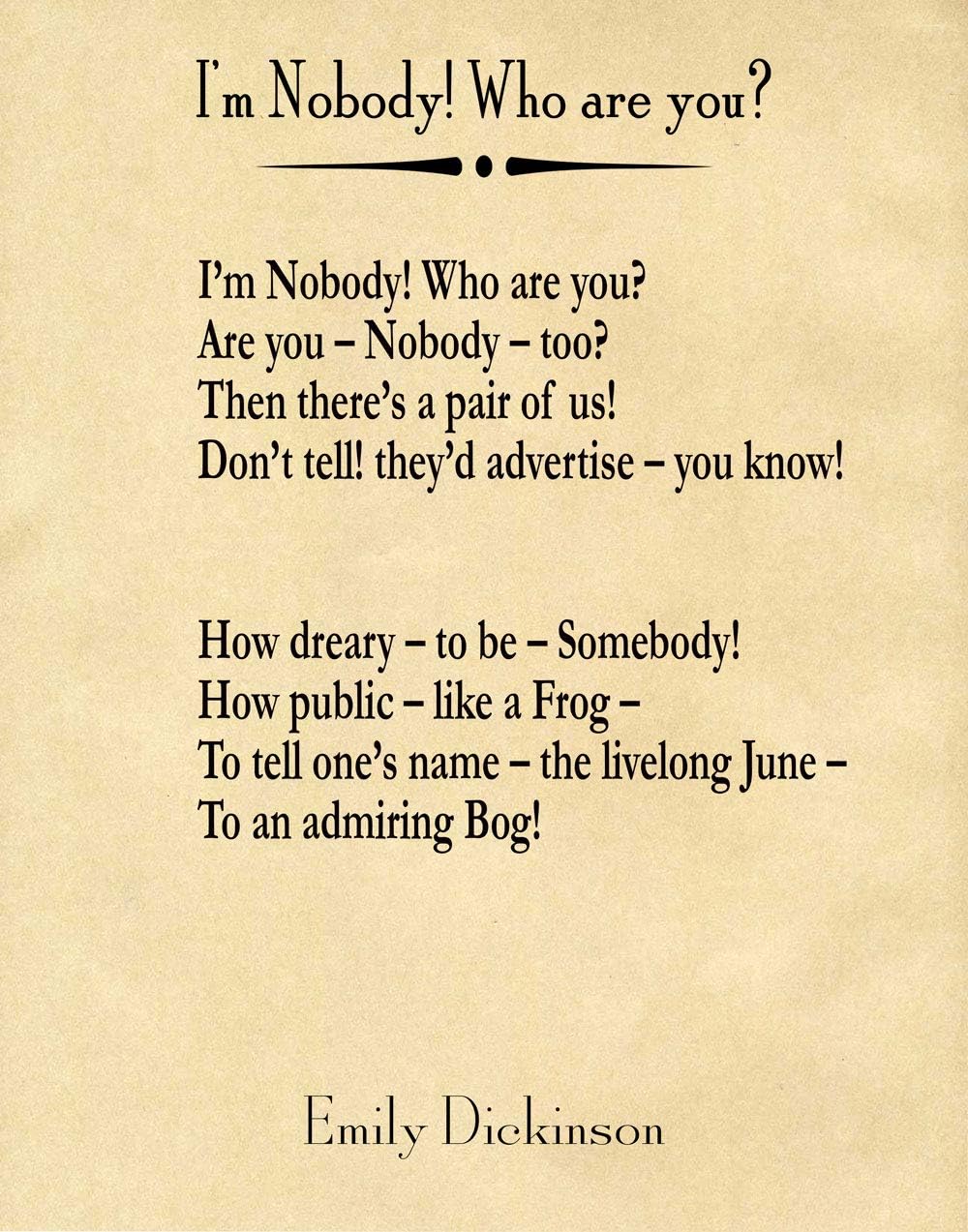
Emily Dickinson was relatively unknown during her lifetime. Yet after her death, her poetry endured in hearts for generations.
We spied the butterflies, inside cocoons, asleep before their dreams became the truth like hearts pulsating seeking summer’s moons and mothers letting children shed their youth.
We will escape the cupboards after spring when motors growl upon the interstate. We’ll rest our trinkets, learn a slugger’s swing, and join the jamborees and snooze past eight.
We’ll wake and race against each fading day, baptize the stars, assemble rocket ships then write the songs that point toward the way.
So when we creep into our endmost drips, exposed, recorded every blink and breath; we’ll find our journey shall survive past death.
Frank Gotch and George Hackenschmidt shaking hands with Referee Ed Smith before the legendary match in 1908
Frank Gotch was a farm boy from Iowa. Gotch was born to German immigrants three miles south of Humboldt. Growing up, he wrestled pigs, wrangled horses, and threw around large bails of hay. But he never imagined he would be taking center stage in Chicago, at Dexter Park for the chance to become Heavyweight Champion of the World.
It was approaching match time. The third undercard was on its way. Gotch picked up a telegram he had received from President Roosevelt where he wished him luck in tonight’s match against The Russian Lion, George Hackenschmidt. The President also emphasized how he admired Hack, but he could not root against his country.
Farmer Burns, Gotch’s trainer, was in the next room discussing things with the referee for tonight’s match, Ed Smith. And after a long conversation with Smith, he came back into the locker room. He grabbed a can of oil and handed it to Frank.
“Here, rub it in good.”, Burns said.
Gotch applied the oil generously to his entire body. Then off in the distance, the crowd went into a roar, and the bell rang rapidly.
“It’s about time.”, Burns noted.
Gotch put on his robe and then exited the locker room and began his journey towards the ring. Across the way, he could see Hackenschmidt. Indeed, Hack lived up to his reputation. His arms looked like cannons marched out for war.
Chicago policemen were waiting for Gotch to walk him to the ring. Gotch greeted the officers as the crowd erupted when he came into view.
“That’s my cue.”, Gotch said to Burns, and he proceeded down the aisle with Chicago’s finest. As Gotch entered the ring, the crowd quieted a bit. And then suddenly, the crowds’ roar redoubled in intensity as Hackenschmidt entered the aisle.
George Hackenschmidt was one of the most famous people in the world. Consequently, he rubbed shoulders with royalty and commoner alike. The Russian Lion was known for his gentle demeanor and cultured personality. Still, the newspapers were hyping the match with a sense of patriotism for the American, Gotch, but Frank began to doubt these sentiments after hearing the crowds’ reaction for Hack compared to his.
Hackenschmidt entered the ring. Smith called both men to the center of the mat. “Listen boys this is a catch-as-catch-can match. All holds below the belt are legal. There will be no closed fists, kicking, eye-gouging and chokeholds. This is a winner by submission or pinfall match. I want a good clean match.”
Both Hack and Gotch nodded to the ref. And as the two wrestlers shook hands, Gotch said to Hack, “Smile a bit, would ya.” And the two went back to their respective corners to disrobe. Hackenschmidt was wearing trunks, and Gotch, full-length tights.
Farmer Burns looked at Gotch and reminded him, “Remember, Hack has strength over you, don’t let him overpower you early.”
The ringside bell rang, and the crowd went into a frenzy. The two wrestlers went forward and met each other in the middle of the squared circle. They faced and danced around each other, with arched backs, slapping each other’s hands away. Hack lunged forward several times to try and put Gotch in his bear hug. Each time, Gotch moved swiftly out of the way to avoid the grip.
The crowd became restless, booing each time Hack failed to take hold. Finally, as Gotch moved in to attempt to pull Hack off of his feat, Hack pulled him in and secured his bear hug. Gotch squirmed around in his arms as the crowd cheered and stood in unison. But it was short-lived. Gotch fell out from under Hack’s arms and ran away. Hack again lunged towards Gotch and caught him again, but this time, from behind. As Gotch was flaying in Hack’s arms, his head hit Hack straight in the nose, making it bleed a bit. Hack was stunned, and again, Gotch got away.
Gotch was now keeping a healthy distance from Hack. But occasionally, Hack would again get in and grab Gotch and attempt to squeeze the life out of him. But Gotch would always twist and slide out of Hack’s clutch. And each time Gotch escaped and avoided Hack’s hug, the crowd would burst into jeers.
Hack then turned to referee Smith and shouted a complaint. “He’s covered in oil. Not fair.” The referee ignored Hack. Hack continued to complain and requested, “Let’s take a break? Shower off oil?” Ed Smith replied with an emphatic “Absolutely not! You should have said something before the match.” The crowd had heard him too and somewhat soured a tad on the Russian Lion.
“What’s a matter, Hack? Can’t get a grip?” Gotch taunted.
This routine continued for another hour or so. Gotch would taunt and skip around arm’s length from Hack, as Hack would grow increasingly more frustrated. And every time Hack would somewhat snatch Gotch, Gotch would again slither away due to the oil.
At long last, Hackenschmidt got Gotch into a good grip and pulled Gotch in tight. Frank Gotch grunted and hollered, flailed his hands with closed fists, and with several punches hitting Hack’s jaw and nose. Then Gotch reached open-handed towards Hack’s face to push his head away. While doing so his fingers went far up into his nose. When Gotch pulled back his fingers, Hack let out a loud sneeze. Next, Gotch dug his fingers into Hack’s eyes and gouged them. Subsequently, blood started to fall down Hack’s face and onto the wrestling mat.
Hack complained about the dirty tactics, and the crowd hissed at the rough play. Even though the crowds’ cries of “Cut it out!” became more and more distinguishable, Ed Smith shrugged his shoulders at the bulling. And the foul play continued every time Gotch fell into Hackenschmit’s hold. Eventually, Hack propositioned Referee Smith, “Let’s call the match a draw.” Then Gotch shouted, “Let’s wrestle!”, and after hearing Gotch, the crowd, in support, belted out a scorching howl.
Nearly two hours have passed since the bell had initially rung. Hackenschmidt began to tire as he began to wear a mask of blood. And the crowd, clearly now on the side of Gotch, despite his unsportsmanlike conduct, had been growing exhausted by the match.
Suddenly, Gotch wrestled Hack to one knee and then to another and then pushed him face-first into the mat. The crowd jumped up as Gotch went towards Hack’s leg. Frank Gotch grabbed Hack’s ankle and twisted it up along Hack’s side forcing him around onto his back. Gotch leaned into his leg and the ref began a pin count.
“One… Two…”, Smith counted.
Hack lifted his shoulder off the mat and turned back over to his side, avoiding the three count. Gotch let go and then reapplied the toe-hold as Hack shrieked in extreme pain. Hack was fighting against being put on his back again until he gave in and shouted to Smith, “I surrender, I surrender, I surrender!” Referee Smith shouted, “Release the hold, Gotch!”
Gotch let go, and Smith pointed towards ringside. The bell rang mercisously as the crowd exploded in hysteria. Smith raised Gotch’s arm in victory, and the crowd started rushing the ring. There was a new Heavyweight Champion of the World, a farm boy from Iowa named Frank Gotch.
It was a snowy day in December. I was invited to an address in Manhattan’s lower east side to interview God. The invitation came with an old college paper I wrote. My paper’s thesis was on healthy discourse in American media, written at the height of Bush’s War on Terror. The essay was old, yellow, brittle, and littered with my professor’s marks and thoughts with a big red A at the bottom of the last page.
Was this some sort of joke? This was the first I had seen the paper since I handed it in back in 2003. Why was my old professor wanting to reconnect after all these years? I didn’t even remember her name. Nevertheless, I was intrigued by this invitation which otherwise would have ended in the trash.
I knocked three times on the door. After a minute, I heard jostling behind the oak gateway and what sounded like several deadbolts being unlocked. After that, the door opened gradually to reveal an elderly man who wore a Mickey Mouse t-shirt, cargo shorts, and flip-flops. His long gray hair was tied in a ponytail with a Salvador Dalí mustache to match.
“Well are you going to come in?” he said in a strong New York accent.
I didn’t say a word and didn’t know what to say, but I tried not to look confused and entered. The elderly gentleman led me down to his dimly lit cellar. The basement flat smelled of reefer and freshly brewed coffee. The old man walked towards the pot at the end of the room and offered a cup. I nodded.
“You don’t say much.”, he said.
“Oh, I’m sorry, I am here for an interview.”
“An interview with who?”
I stared towards the ceiling for a bit, looked back at the old man, and stuttered a few incoherent sounds.
Before I could complete a word, he spoke, “Never mind, let’s have us a seat.”
His head pointed towards the long beat-up leather couch sitting before a TV that had been playing random YouTube videos on mute since I entered the room. He and I sat. The old man reached over to the side of the couch and pulled out a glass bong. The old man lit his lighter and sparked the cannabis, and inhaled off the end of the glass tube. He then released the fumes into his lungs. He exhaled a massive amount of smoke, and without a cough, he packed more weed in the bowl. Then he passed the bong to me.
“No, thank you.”, I said.
“Suit yourself.”
He repeated the bong process. I had then lost my patience and composure. Immediately, I put down my cup and rose.
“I made a mistake. I must be going now.”
“But, you have come such a long way.”
“It was only a twenty-minute train ride, and now I must be on my way.”
The old man grinned and made a point of not laughing. Suddenly, the room and the old man had vanished before my eyes. With a sober panic, I stood in a vastness of white nothingness which seemed to go on forever in all directions. Minutes passed by. Nothing had happened.
“Hello.”, I finally shouted into the endless light. There was no echo and no response. Then, poof, I was back in the old man’s basement. I sat down and looked mysteriously at the cup of coffee I had previously sipped and placed on the floor. I turned to the old man.
“Are you God?”
“Do I look like God?” he laughed.
“I don’t know what God looks like. I don’t even know if there is a God.”
“Me neither,” he replied.
“Perhaps, you drugged me.” I looked again towards the cup on the floor.
“What was that place?” I asked.
“What place?”
“The place I just came from, the infinite white nothingness.”
“You were here the entire time.” he paused. “And you always have been there.”
“Are you God?” I asked again.
“No more than you.”, he answered.
“Are you some sort of wizard, like Gandalf?”
He laughed. “I have been given all sorts of names. Well, not much as of late. It’s kind of a relief not having people believing in me so badly. Sometimes I find it hard to believe in people too. But I still do. Besides, who’s going the land the planes?” He paused for a bit and continued. “They used to kill animals for me, you know. Do you know how many adorable little lambs were killed for me? It was disgusting, like a cat leaving a dead bird at your door. But you know, people, they moved on from that. They don’t cure diseases for me, but people still do. People do all sorts of things that please me.”
“Why the old college paper?”
“I found it in some storage box I was asked throw away when I was working as a janitor a few years back. I knew it would get your attention. What? You want a burning bush. Been there, done that. And you need to get back to writing, and I saw this as an opportunity. That empty void you saw and the blank page isn’t much different.”
At this moment, my eyes began to look intensely at the old man. I grabbed my pen and pad and asked, “Why me? What makes me so special?”
He chuckled. “You are not all that special aside from the reasons your mother may think. I could have sent another invitation to a litany of others.”
“So this is why we are here? To fill in the void?”
“Yeah! Otherwise, there wouldn’t be anything. The world exists because it is experienced. It isn’t the other way around. A world not aware of itself doesn’t exist. How could it? There would be no purpose.”
“Are you God?” I asked one more time.
He laughed again. “Do I need to show you the infinite white again? I know people have a desire to believe there this some sort of great conscious power controlling everything. There simply isn’t. If you want to call the primordial void God, then this is what I am, but you are filling it in as well.”
“You mentioned the burning bush. What about Moses and the Ten Commandments? In them, it says there are no other gods beside me?”
“They were worshiping a golden calf and had lost their way. Something needed to be done about that mess. Moses led them out of the wilderness, didn’t he? Sometimes humanity needs a little nudge.”
“Is Jesus the Son of God?”
“Jesus said we are all children of God. Why would he think anything different of himself? It is the church that perverts this message. They can’t have everyone walking around thinking they are part of God. They would lose all authority. Jesus also said that the Greatest Commandment was to love God with all your soul and do this by loving your neighbor. Yet a lot of so-called Christians focus on the loving God part, not so much the neighbor.”
“Do you answer prayers?”
“The human mind is like a computer terminal connected to a massive database. When we die, those thoughts don’t just evaporate. Every thought, word, action is recorded for all time and for all to see. I am the database.”
The music of Franz Schubert’s Ave Maria began to fill the basement flat from a small window at the end of the room. Suddenly, God went into his pocket, pulled out his cell phone, and made a call. “What is the problem?, God said into the phone. “Yes. Yes, I understand. I will be there soon.” He hung up the phone and turned to me, and said, “I must cut this off short.” And God started to guide me up the stairs.
“Who was that?” I asked.
“That was one of my messengers. There is a problem in a maternity ward in Moscow.” He then opened the door and said, “Farewell for now.”
I turned around, and the door had already been shut behind me. Outside the door were Christmas carolers finishing up their rendition of Schubert’s masterpiece with the most angelic voices I had ever heard. They had sung their last note, and a child in the center of them raised a container for a donation. I dug into my pocket to find all the money that I had. I found a few bucks and placed them in the jar.